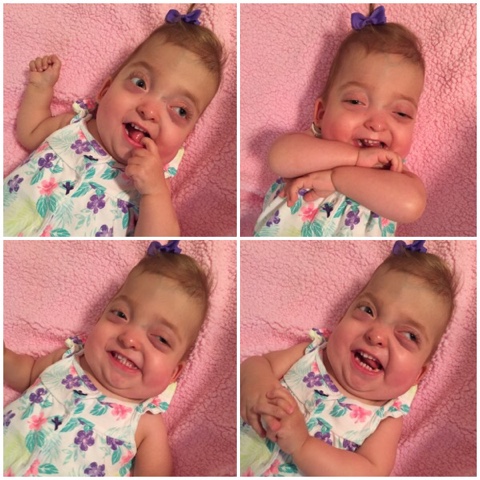
Our baby bird is 23 months old today! She has about 20 signs that she uses regularly now and seems to be understanding more and more every day. In the last week she decided that she can stand up from a bench-sit without using her hands and even balanced for a couple of seconds with zero assistance! Abby has also recently started using one finger to point at everything! She would be happy to have us read book after book after book to her all day long (her current favorites being
Chicka Chicka Boom Boom,
Llama Llama Red Pajama,
Baby Beluga, and Sandra Boynton's
Doggies;
Moo, Baa, La La La; and
Snuggle Puppy). She likes to open all of the doors and cabinets in the house, point to the babies in her books, torment the dogs, pop bubbles, and make hilarious faces at herself in the mirror. Everything is a phone, and if you don't "answer" whatever she hands you, she is clearly unimpressed. We are loving this fun age and seeing her vibrant and spirited personality blossom.
Heart symptoms have been holding steady over the last week or so. She's still grunting quite a bit, especially in the afternoons, has continued to vomit daily, and is frequently sweaty, but we are incredibly grateful that these things haven't gotten noticeably worse since her surgery was scheduled. We've been on total germ lockdown for about a week now, and will be until we head to Houston - it would absolutely disastrous if she got sick going into open heart surgery, so we're doing our very best to limit her exposure to unnecessary risks. While we've been confined to the house (no therapies or appointments even), it has been so nice being able to spend this pre-op period at home, instead of inpatient.


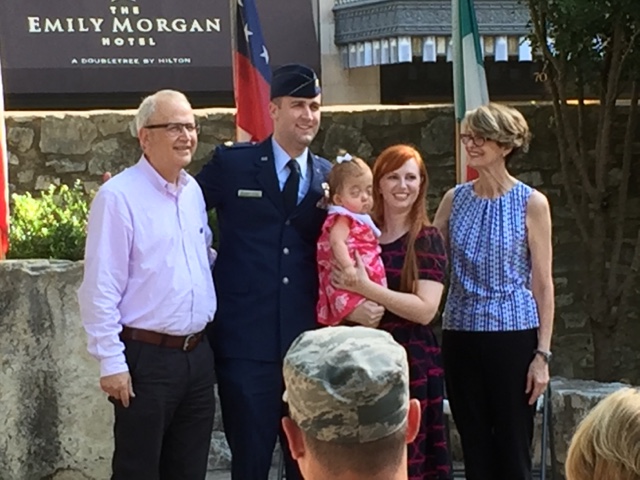
Though we've been a little isolated from the world, we were thankfully able to visit with lots of family recently for Jameson's promotion ceremony as well as the 4th of July. Other notable moments from the last few weeks include a lovely Father's Day, and getting to squeeze in our annual family pictures before going on lockdown.
We will be heading to Houston on Tuesday, Aberdeen's pre-op appointment with the surgeon, child-life, and cardiac anesthesia is on Wednesday, and surgery is scheduled for first thing Thursday morning. Apparently there have been a number of emergency surgeries in the last week that have required shifting of the surgical schedule, so there's always a possibility that Abby's surgery could get bumped - but due to her current symptoms, we're hoping that doesn't happen.
Thank you all for your continued prayers and well-wishes. We are very very nervous heading into this surgery. Some of that anxiety stems from the fact that it has been a long time since Abby has had a major surgery, or even a sedated procedure at this point. Additional anxiety is coming from the memory of how tenuous things were after Aberdeen's first heart surgery. Ultimately, we don't know what Abby's recovery period will look like this this time around. Some things are much improved with her health, but her hypertrophy is much worse, which can complicate recovery greatly. We hope that because she is bigger and stronger now, she will do better, but still anticipate that she will do things in typical (or atypical), exciting Aberdeen fashion. We are concerned about having a major surgery away from the comfort we found at CCHMC with the doctors, nurses, social workers, and facility we came to know and trust so well - as well as the concern about having a surgery that is over three hours away from our home, if her recovery is lengthy. We're trying to trust that this is what Aberdeen needs to continue to grow and thrive, and just enjoy these next couple of days, but we are admittedly on edge. We appreciate any prayers and good thoughts you may be able to spare. Additionally, we have a couple of Aberdeen's buddies on our hearts as they celebrate challenging anniversaries this month and face their own surgeries, if you could spare a thought for the families of Ben, Ellie, and Tillery, I know they would be most appreciative.
I can't believe that only one month from today, we will be celebrating Aberdeen's second birthday. My heart is so full of love for her and I am so incredibly proud of the spunky little fighter that we've been blessed with.
For those interested, I have included below the Cleveland Clinic's description of the surgery Aberdeen will be having performed: a septal myectomy. While this article is geared toward adults, as opposed to pediatric patients, most of this information seems to be consistent with what we have been told thus far.
______________________________
What is septal myectomy?
Septal myectomy is a surgical procedure performed to reduce the muscle thickening that occurs in patients with hypertrophic cardiomyopathy (HCM). Septal myectomy is one treatment option for HCM when symptoms persist despite optimal treatment with medications, or if obstruction severely restricts blood ejection from the heart.
During the septal myectomy procedure, the surgeon removes a small amount of the thickened septal wall to widen the outflow tract from the left ventricle to the aorta. This eliminates the obstruction and the mitral valve regurgitation that occurs with this condition. Patients often experience rapid relief of symptoms after the procedure.
Septal myectomy is a surgical procedure performed to reduce the muscle thickening that occurs in patients with hypertrophic cardiomyopathy (HCM). Septal myectomy is one treatment option for HCM when symptoms persist despite optimal treatment with medications, or if obstruction severely restricts blood ejection from the heart.

During the septal myectomy procedure, the surgeon removes a small amount of the thickened septal wall to widen the outflow tract from the left ventricle to the aorta.
Who is eligible for the myectomy procedure?
Patients with a diagnosis of hypertrophic cardiomyopathy should be assessed at an experienced center to determine the severity of their condition and to develop a treatment plan.
It is estimated that obstruction occurs in more than 70 percent of patients with HCM. The severity of obstruction, symptoms and the patient’s response to medications vary greatly. Many patients have no symptoms or mild obstruction and can be treated with medications like beta blockers or calcium channel blockers.
Septal myectomy is the safest, most successful and most durable procedure for patients with severe symptoms or severe obstruction. Elderly patients or those with advanced medical conditions may be better served by percutaneous alcohol septal reduction.
Hypertrophic cardiomyopathy (HCM) is a complex type of heart disease associated with a thickening of the heart muscle, most commonly at the septum (the muscular wall that separates the left and right side of the heart), just below the aortic valve. If the septum becomes too thick, the passageway to the aorta becomes very narrow, limiting or blocking the flow of blood from the left ventricle to the aorta, called “outflow tract obstruction.” The septal thickening that results in obstruction varies from a few millimeters to centimeters. Mitral valve abnormalities are common and impact repair techniques.
What tests are needed before the surgery?
- A detailed echocardiogram (echo) provides information about heart function and septal wall thickness. Specialized echo tests may include exercise or the use of special drugs and may be needed to define the severity of obstruction and to assess the mitral valve
- If you do not have an implantable defibrillator or pacemaker, an MRI may also be obtained to evaluate the mitral valve structure and function.
- A diagnostic cardiac catheterization should be performed.
- Routine blood tests, a chest X-ray and an electrocardiogram will also be performed.
What are the possible risks of the surgery?
Your doctor will discuss the specific risks and potential benefits of the septal myectomy procedure with you. The procedure is generally very safe. However, as with any surgical procedure, there are risks related to your age, the presence of other medical conditions and the number of procedures you undergo during a single operation.
Specific risks may include: infection; irregular heart rhythm, such as ventricular arrhythmia; chest pain or angina; heart attack, stroke or death. Special precautions are taken to reduce these very low risks.
What can I expect before the surgery?
Before your surgery date, you will have a presurgical appointment where you will receive specific instructions about when and where to report for surgery, what to expect before and after surgery, and whether additional tests are needed. If you need to see another health care provider or need testing during this preoperative appointment, you may be at Cleveland Clinic all day or you may need to return another day.
During this appointment, you will have the opportunity to talk with a nurse or patient educator about the procedure. You may also meet with your surgeon and anesthesiologist.
If you are already in the hospital and surgery is recommended, your health care team will give you information about pre-surgical tests and how to prepare for surgery.
What happens during surgery?
Anesthesia: General anesthesia is administered by a cardiothoracic anesthesiologist before surgery. The anesthesiology team uses state-of-the-art equipment and monitors to ensure you are safely anesthetized during the procedure.

Type of incision: A 6- to 8-inch incision is made down the center of the chest, dividing the sternum (breastbone) to provide the surgeon direct access to the heart.
The thickened muscle is approached through the aortic valve so that no direct incisions into the heart muscle are required. The cut muscle heals on its own without needing to be sutured.
Heart-lung machine: The heart-lung machine, or cardiopulmonary bypass, is used during the procedure and takes over the heart’s normal functions so the surgeon can perform the procedure on a “still” heart.
Blood is routed through the heart-lung machine, and oxygen and carbon dioxide are exchanged in the blood by the machine and then pumped back into the body. By doing the work of the heart, the heart-lung machine helps protect your other organs while your heart is stopped. After the procedure is complete, the heart-lung machine is turned off, the heart starts beating on its own, and the flow of blood returns to normal.
Pacing wires: Temporary pacing wires and a chest tube to drain fluid are placed before the sternum is closed with special sternal wires. Then the skin and subcutaneous tissue is closed with internal, absorbable sutures. Sometimes a temporary pacemaker is attached to the pacing wires to regulate the heart rhythm until your condition improves.
How long does the procedure last?
The actual surgery lasts from 3 to 6 hours, however your family should expect additional time before and after surgery.
What should I expect after the surgery?
You will be transferred to an intensive care unit for close monitoring after the surgery. The monitoring during recovery includes continuous heart, blood pressure and oxygen monitoring and frequent checks of vital signs and other parameters, such as heart sounds.
Some patients may require an implantable cardioverter-defibrillator (ICD) to treat a serious abnormal heart rhythm. If this device is required, your cardiologist will discuss the details about the device and the implantation procedure.
Under certain circumstances, you may have a test called an EP study (electrophysiology study) before you go home to evaluate your heart rhythm.
Before you leave the hospital, you will receive specific information about incision care, medications, activity and diet guidelines, warning signs to look for and who to call after you go home.
Medications after surgery: You will continue to take your preoperative medications, as directed, until your follow-up appointment when your cardiologist may make adjustments to your medications.
Will my symptoms improve after surgery?
Yes. Surgical results indicate that most patients experience significant symptom improvement and an improved quality of life after surgery.